

4K 2Port,3Port, 4 Port Multi-Projector Blending Processor with software
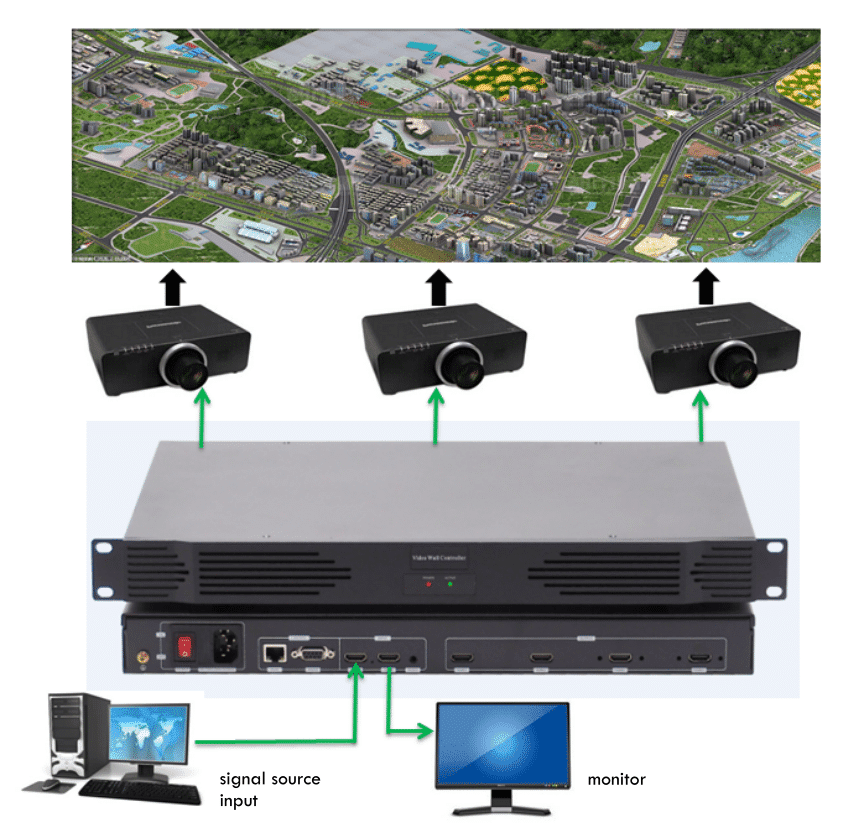
Multi-projection splicing fusion processor is also called edge fusion processor. The main function is to splice and fuse multiple projector display units into an ultra-high-resolution logical display, which can realize full-screen clear display of ultra-high-resolution electronic maps, geographic information systems, industrial flow charts, industrial monitoring information and reate a seamless, unified image.
Edge blending processor Provides a unique, cost-effective solution for boardrooms, classrooms, digital signage applications, and worship and presentation environments looking to drive seamless digital content on up to eight projectors in a wide range of configurations.
The processor is a professional high-end graphics processing equipment, specially designed for seamless splicing systems for large-screen projection.
It has a built-in multi-screen graphics splicing processor and fusion band generation device, integrating video processing technology and edge fusion technology.
Functions such as video edge blending, chromatic aberration correction, trapezoidal and arc correction are perfectly realized on one controller.
Support N*M seamless splicing display. The edge blending processor supports any customized equal-proportion EDID input and can display the size ratio according to the projection. Modify the input EDID to allow the computer graphics card to output in equal proportions, and finally convert it to a fixed 1024×768/60Hz-1920*1080/1200/60Hz HDMI format output.
It adopts pure hardware design and does not require operating system. It ‘s plut and play with high stability. The dynamic images are natural, smooth, clear and gorgeous, and the cost is competitive than similar products in the market.

Features:
- Auxiliary adjustment of projector brightness and color
In the fusion display project, there are some differences in color and brightness between different projectors. The fusion processor can correct the color and brightness of different projectors to achieve consistency in brightness and color of each projector.
Supports color gamut correction technology. Due to production process reasons, even if you use projectors of the same brand, model and batch, there will be color differences between the two projections. Through the color gamut correction system that comes with the Xianhe processor, each projector can be corrected. The picture output by one projector is independently adjusted, so that the colors output by multiple projectors are consistent, and the color consistency of the image after fusion is better.
- Arbitrary geometric correction
In fusion display projects, the display area projected onto the screen may not be completely flat, especially in complex occasions such as surface fusion, circular fusion, and spherical fusion. This requires the fusion processor to be able to make any position of the projected image geometric correction.
Support arbitrary surface image correction, independent grid generation, pixel-level adjustment, arbitrary setting of nodes to complete local adjustment, image correction on special-shaped screens, support for various special-shaped fusion modes, and the fusion systems that can be realized include: spherical surface, dome screen, Folding curtain, wavy surface, etc.

- Passive 3D fusion
Passive 3D stereoscopic fusion refers to a stereoscopic projection system consisting of at least two projectors. The front ends of the two projector lenses are each equipped with a polarizing filter in opposite directions to project left and right eye images respectively. The viewer in front of the screen wears passive polarized glasses. The polarization directions of the two lenses on the glasses are consistent with the polarization directions of the two polarizing filters in front of the projector lens, so that the viewer’s right eye can only see the right eye image. , and the viewer’s left eye can only see the filtered left eye image, thus giving the viewer’s brain a three-dimensional feeling.
However, the area and resolution projected by a single projector are limited. In order to achieve a 3D stereoscopic effect with a larger area and larger resolution, an edge fusion processor can be used.
- Dark field compensation mechanism
Light leakage from the projector means that when the projected image is completely black, part of the light from the projector can still be projected onto the projection screen. In this way, after the two projectors are superimposed, a bright band in the middle will appear in a pure black field. The fusion processor needs to counteract this bright band by increasing the light intensity of the non-superimposed part. This process is called dark field compensation.
Due to the projection process, whether it is a DLP or LCD projector, there will be light leakage to varying degrees when outputting a pure black image. When two projectors output darker images at the same time, a superimposed light leakage band will be formed. Fusion processing The device can eliminate the light band through its own unique light leakage band processing technology, making the transition of the black field image smooth and natural.
- Backplane exchange technology
Different from the time-division multiplexing technology used in the PCI bus structure, the backplane switching technology allows each input and output channel to use an independent data channel. At each moment, the edge fusion processor can transmit all video data in parallel, ensuring that the system video The real-time nature of data exchange. In many large-scale splicing and fusion systems, it can also ensure that the real transmission of video data does not lose frames.
- Fully synchronous data processing technology
The splicing fusion processor is a single-clock pure digital image processing device. All signals are processed simultaneously under the control of the system’s main clock, achieving a fully synchronized system effect, thus fundamentally eliminating the problem of signal desynchronization. When playing high-speed dynamic video, the image is neat and smooth, and there is no image tearing phenomenon.
- Pure hardware architecture, stable and reliable
It has excellent image processing performance and completely avoids the problems of slow startup speed of PC architecture, hardware conflicts and computer viruses. The mean time between failures (MTBF) is >30,000 and can work continuously for more than one year.
- Output synchronization and double buffering technology ensure output synchronization
Seamless switching of scene plans with no limit on the number, truly realizing synchronous display of pictures, ensuring no tearing, no flickering, no blue screen, no static and other abnormal phenomena.
1 1. Multi-screen interaction
Multi-screen interaction, as the name suggests, refers to the interaction of audio, video, pictures and various document resources between mobile phones, tablets and large-screen splicing walls. It is a quite “trendy” function that can bring users an excellent experience and fun. Safety, convenience, simplicity and ease of use, bringing the joy of touch control to the extreme.
1 2. Support cascade control of multiple devices, etc.
1.3. Support custom development
Control port
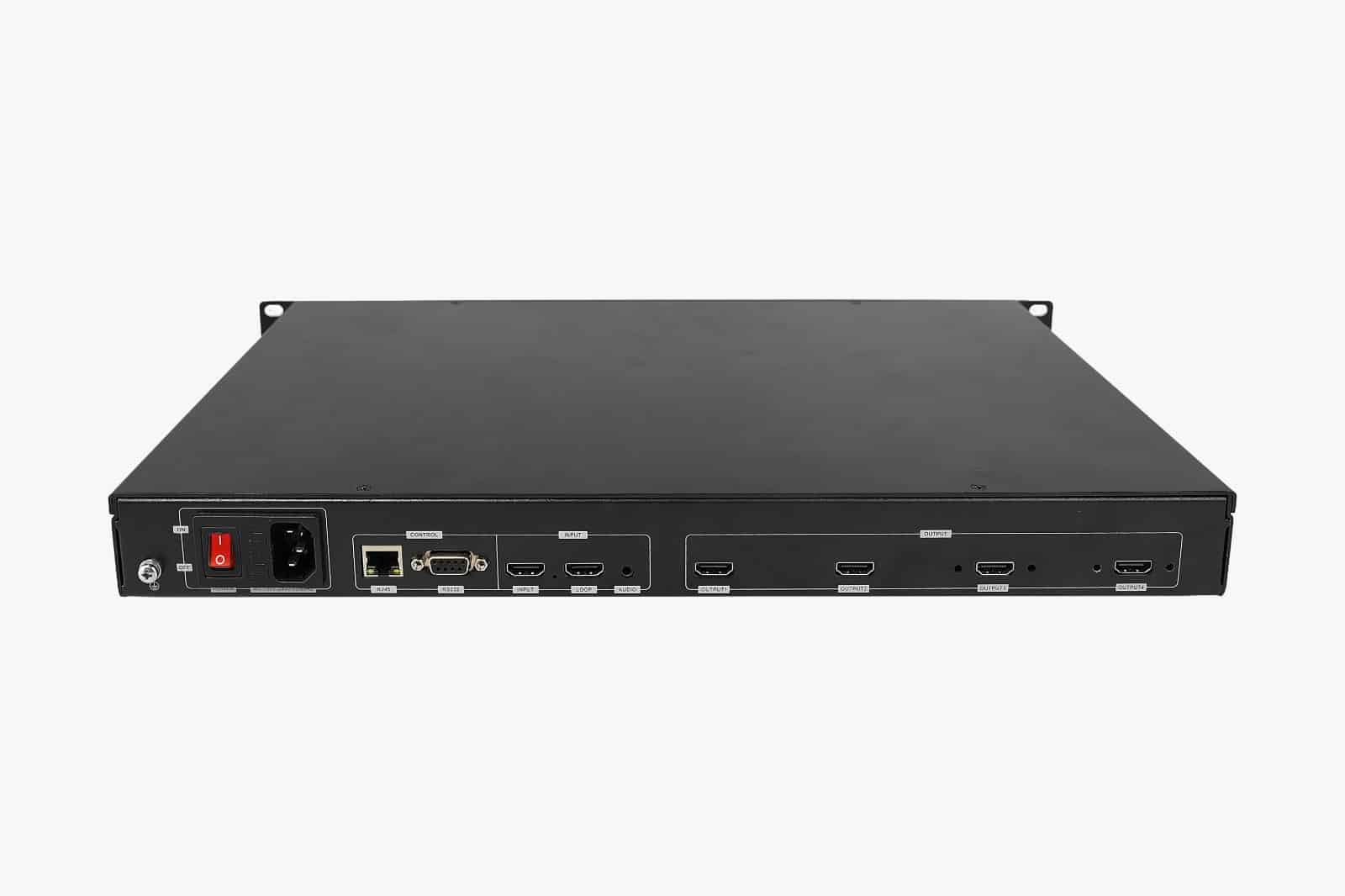
The control methods supported by the device are as shown in the following table:
| control port | illustrate |
| Network port | Network Interface. Connect to the local area network through the network cable or directly connect to the computer for host computer control. |
| serial port | RS232 . The device can be controlled by connecting the device through the serial port. |
Device software operation
Software brief introduction
Transform Fusion software is a new generation of visual, WYSIWYG control software. This control software integrates the application characteristics of splicing and fusion products and is developed based on the characteristics of engineering installation.
Adopt the current cutting-edge concepts of software design, abandon the complex debugging requirements of traditional equipment control software, implement automatic calculations for the fusion process, and adopt a WYSIWYG operating interface for the window control process to avoid the cumbersome and complicated presets of traditional splicer software.
During the process, users can quickly master the various applications of the software. The software interface is simple, easy to operate, and easy to understand and use.

If your project don’t have your own blending software, you can choose this model ,every output port with software. 8K edge blending processor will coming soon.
If you have blending software, then we also have another processor which can meet your requirement with wholesale price, whether your projector with HDBaset port or without, we can offer you HDBaset port processor for your application.All is FPGA chip set, it’s stable and easy operation.

We also have wireless 4K60 HDMI Edge Blending Processor Box


